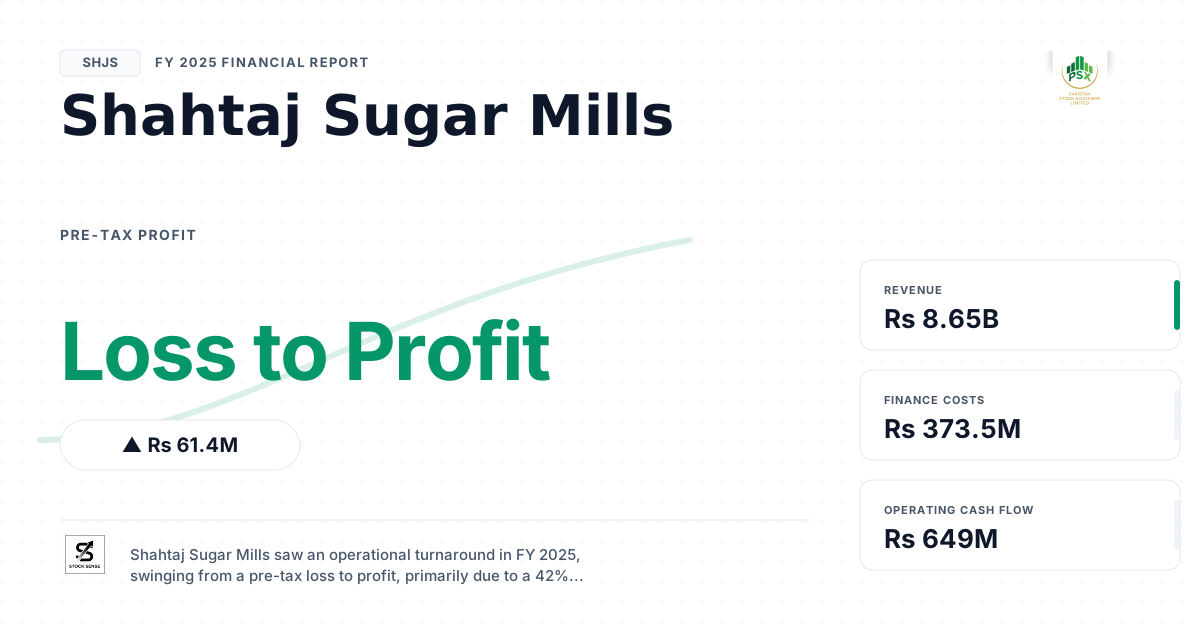
Shahtaj Sugar Mills Limited (SHJS) has announced its financial results for the year ended September 30, 2025, revealing a significant operational turnaround. Despite a marginal dip in top-line revenue, the company successfully swung from a substantial pre-tax loss to a profit, primarily propelled by aggressive finance cost management and a dramatic improvement in operating cash flow. Notably, the Board of Directors has opted not to recommend any cash dividend or other benefits for shareholders this year, signaling a focus on balance sheet strengthening.
Financial Performance Highlights
The company's revenue from contracts with customers experienced a slight decrease of 1.95%, settling at Rs 8.65 billion in 2025 compared to Rs 8.82 billion in 2024. Gross profit also saw a modest decline of 7.34% from Rs 927 million to Rs 859 million, indicating some pressure on sales or production costs. However, the most impactful change came from finance costs, which plummeted by an impressive 42.06% from Rs 644.7 million in 2024 to Rs 373.5 million in 2025. This substantial reduction was the pivotal factor in transforming a 'Profit / (loss) before income taxation' of Rs (178.0) million last year into a positive Rs 61.4 million this year.
After accounting for income tax and levy, SHJS reported a net profit for the year of Rs 32.68 million, a marginal increase of 1.66% from Rs 32.14 million in the previous year. This translated into a slightly improved Earnings Per Share (EPS) of Rs 2.72, up from Rs 2.68. Crucially, the Statement of Cash Flows reveals a dramatic shift: net cash generated from operating activities turned strongly positive at Rs 649 million in 2025, a significant reversal from a negative Rs 639 million in 2024. This turnaround underscores a much healthier and more efficient core business operation.
Key Drivers of Profitability
The primary drivers for this year's improved profitability are evident:
- Reduced Finance Costs: A substantial 42.06% decrease in interest expenses, likely due to active debt management and potentially lower borrowing rates, was the single largest contributor to the profit turnaround.
- Increased Share of Associate Profits: The company's share of profit from associates more than quadrupled, soaring by 312.87% from Rs 5.5 million to Rs 22.6 million, providing a healthy boost to the bottom line.
- Higher Other Income: Other income also increased significantly by 57.86% from Rs 52.5 million to Rs 82.9 million, further supporting overall profitability.
While revenue saw a slight dip, the company effectively managed its overall cost structure. However, 'Other operating expenses' saw a massive increase of over 3,500%, rising from Rs 0.88 million to Rs 32.0 million, a point that warrants close monitoring by investors.
Management's Strategic Focus
Management's actions clearly indicate a strong focus on strengthening the balance sheet and enhancing financial efficiency. The significant reduction in short-term borrowings by approximately Rs 448 million (from Rs 1.83 billion to Rs 1.39 billion) is a direct result of this strategy, contributing substantially to the lower finance costs. This deleveraging is a robust positive signal for long-term stability and reduced financial risk.
Capital expenditure, while still substantial, was moderated this year, with property, plant, and equipment acquired amounting to Rs 709 million compared to Rs 1.1 billion in the previous year. This suggests continued, yet more controlled, investment in core assets. The decision to not recommend a cash dividend, despite achieving a positive net profit, reinforces management's preference for retaining earnings to further bolster the company's financial position, accelerate debt reduction, or fund future growth initiatives.
Investor Outlook
For investors, Shahtaj Sugar Mills' latest results present a compelling turnaround story driven by improved operational cash generation and prudent debt management. The decisive shift from a pre-tax loss to a profit, fueled by a substantial reduction in finance costs, is a strong indicator of enhanced financial health and efficiency. The company's proactive approach to de-risk its balance sheet by repaying short-term debt is a positive long-term signal for stability.
While the absence of a dividend might initially disappoint some, it aligns with a strategic imperative to consolidate financial strength. Rational investors should closely monitor for sustained positive operating cash flows, continued debt reduction, and any future guidance on capital allocation or dividend policy. The ability to maintain or grow revenue in the face of evolving market dynamics will be crucial for translating this operational improvement into consistent and attractive shareholder returns.