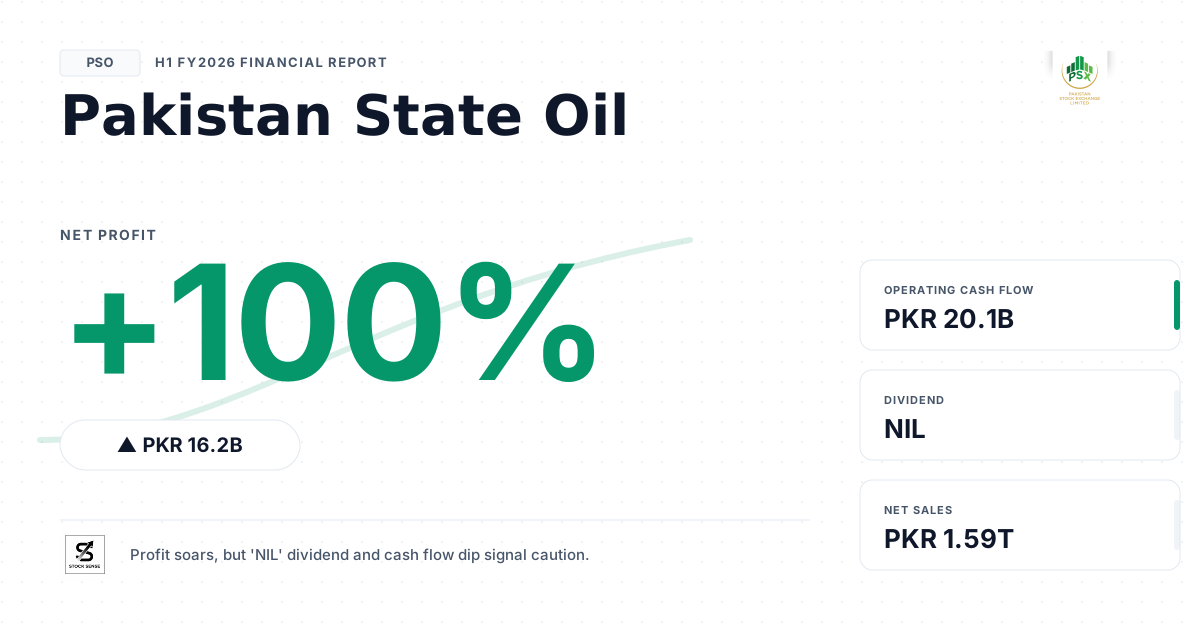
Pakistan State Oil (PSO) has announced a mixed bag of financial results for the half-year ended December 31, 2025. While the company reported a significant increase in consolidated profit for the six-month period, a notable 'NIL' dividend recommendation from the Board signals a cautious approach. Investors should note the significant slowdown in the second quarter and a sharp decline in operating cash flows, which temper the overall positive half-year profit growth.
Financial Performance
For the six months ended December 31, 2025 (H1 FY2026), PSO reported a consolidated profit after tax of approximately PKR 16.2 billion, a substantial increase from PKR 8.1 billion in the same period last year (H1 FY2025). This translated into a healthy rise in consolidated Earnings Per Share (EPS) to PKR 31.34, up from PKR 19.48. However, this positive half-year performance masks a challenging second quarter (October-December 2025, Q2 FY2026), where consolidated profit after tax declined to PKR 5.0 billion from PKR 6.2 billion in Q2 FY2025, with EPS falling to PKR 8.91 from PKR 13.42.
Consolidated net sales for H1 FY2026 saw a decrease to approximately PKR 1.59 trillion from PKR 1.72 trillion in H1 FY2025, indicating potential pressure on sales volumes or pricing. Despite this, the consolidated gross profit margin improved to about 3.50% from 3.03%, suggesting better cost management or product mix. A significant driver for the overall half-year profit improvement was a substantial reduction in finance costs, which fell from approximately PKR 21.1 billion in H1 FY2025 to PKR 13.4 billion in H1 FY2026, reflecting efforts to manage debt or benefit from lower interest rates.
On the balance sheet, total consolidated assets remained stable at around PKR 1.1 trillion. Equity attributable to owners increased to PKR 266.3 billion from PKR 256.9 billion as of June 30, 2025. Notably, short-term borrowings were reduced to PKR 352.1 billion from PKR 371.5 billion, and trade debts also saw a decrease, improving the company's liquidity position. However, cash and bank balances declined significantly from PKR 60.9 billion to PKR 38.7 billion over the six months.
Key Drivers & Segments
The primary driver for the improved half-year profitability, despite lower top-line revenue, appears to be the effective management of finance costs. This suggests that the company has either reduced its reliance on expensive short-term debt or benefited from a more favorable interest rate environment. The slight improvement in consolidated gross profit margins also contributed positively, indicating resilience in core operations.
- Significant reduction in finance costs, down by approximately 36% in H1 FY2026 compared to H1 FY2025.
- Improved consolidated gross profit margin, suggesting better operational efficiency or product mix.
- Reduced short-term borrowings, strengthening the balance sheet.
Management Actions & Strategic Signals
The Board's decision to recommend a 'NIL' dividend, despite a notable increase in half-year profit, is a strong signal of management's focus on cash preservation and balance sheet strengthening. This could be a strategic move to navigate ongoing economic uncertainties or to fund future capital expenditure without increasing leverage. The company's capital expenditure increased to approximately PKR 5.4 billion in H1 FY2026 from PKR 3.2 billion in H1 FY2025, indicating ongoing investment in operations. Notably, net cash used in investing activities decreased significantly to approximately PKR 4.1 billion in H1 FY2026 from PKR 17.2 billion in H1 FY2025, primarily due to a substantial reduction in investments in T-bills during the current period.
A key area of concern is the sharp decline in consolidated net cash generated from operating activities, which plummeted from approximately PKR 118 billion in H1 FY2025 to just PKR 20.1 billion in H1 FY2026. This significant reduction in operational cash flow, coupled with increased cash outflow from financing activities (primarily due to higher short-term borrowing repayments), led to an overall net decrease in cash and cash equivalents.
Investor Takeaway
For investors, PSO's latest results present a nuanced picture. The strong half-year profit growth and improved margins are encouraging, largely driven by reduced finance costs and debt management. However, the 'NIL' dividend and the significant drop in operating cash flows, particularly the weaker performance in the second quarter, warrant close attention. This suggests that while the company is improving its financial structure, operational challenges or a cautious outlook on future liquidity might be at play.
Going forward, investors should closely monitor several factors: the company's ability to sustain its debt reduction efforts, any improvements in operating cash generation, and the trajectory of sales volumes and margins in the coming quarters. The absence of a dividend, despite improved profitability, indicates that the company prioritizes financial stability and strategic investments over immediate shareholder returns. Future dividend policies will be a key indicator of management's confidence in sustained performance.