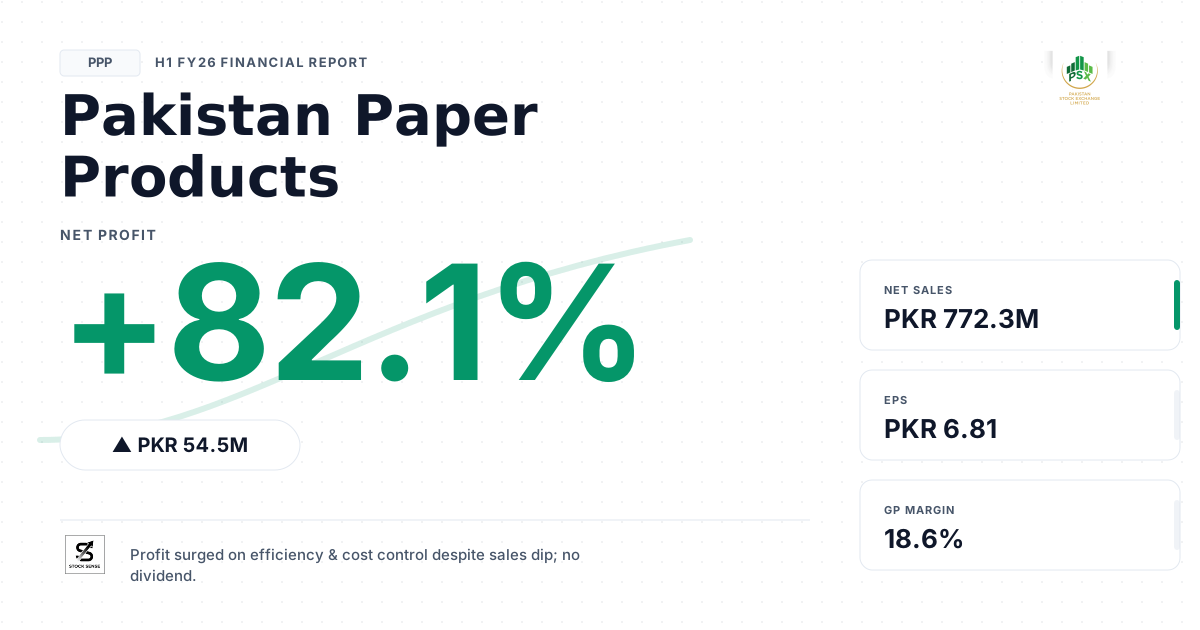
Pakistan Paper Products Limited (PPP) has reported a robust financial performance for the half year ended December 31, 2025, showcasing a significant surge in profitability. While the latest quarter saw a dip in sales, the company's focus on operational efficiency, marked by impressive margin expansion and reduced finance costs, has driven an impressive bottom-line growth. However, shareholders will note the absence of any interim dividend declaration for this period.
Financial Performance Highlights
For the half year (H1 FY26), PPP's net sales grew modestly by approximately 3.8% to PKR 772.3 million, up from PKR 744.1 million in the same period last year (H1 FY25). The real story, however, lies in the profitability metrics. Gross profit jumped by over 20.6% to PKR 143.5 million, significantly improving the gross profit margin from 16.0% in H1 FY25 to 18.6% in H1 FY26. This efficiency translated directly to the bottom line, with operating profit rising by 23.9% to PKR 89.5 million.
A notable contributor to the profit surge was a substantial 21.2% reduction in finance costs, falling to PKR 16.9 million from PKR 21.4 million. This combination of improved operational efficiency and lower borrowing expenses led to an impressive 82.1% increase in profit for the period, reaching PKR 54.5 million compared to PKR 29.9 million previously. Consequently, Earnings Per Share (EPS) climbed to PKR 6.81 from PKR 3.74.
Delving into the latest quarter (Q2 FY26), sales experienced an unexpected decline of about 12.2% year-on-year, settling at PKR 333.2 million against PKR 379.6 million in Q2 FY25. Despite this revenue contraction, the company's gross profit still managed to increase by nearly 13.8% to PKR 65.5 million, pushing the gross profit margin to an even healthier 19.6% from 15.1%. This demonstrates strong cost control and pricing power. Quarterly profit for the period also saw a robust 41.9% increase to PKR 24.3 million (Q2 FY25: PKR 17.2 million), with EPS climbing to PKR 3.04 from PKR 2.15 in the prior year's quarter.
On the balance sheet, total assets remained largely stable at approximately PKR 2.24 billion, showing a minor decrease from PKR 2.244 billion at June 30, 2025. The company effectively managed its working capital, evidenced by a reduction in stock-in-trade and trade debts. Operating cash flow showed significant improvement, generating PKR 77.9 million compared to PKR 47.4 million in the prior half-year, indicating better cash generation from core operations.
Key Drivers & Strategic Focus
While the financial statements do not provide a detailed breakdown by business segment, the primary drivers for this period's performance are clearly:
- Enhanced Operational Efficiency: The significant expansion in gross profit margins, even amidst a quarterly sales decline, suggests effective cost management and potentially favorable input costs or pricing strategies.
- Reduced Finance Costs: A substantial decrease in finance expenses indicates either lower interest rates on existing debt or a reduction in overall borrowing, contributing directly to higher net profits.
- Improved Working Capital Management: A reduction in inventory and trade debts points towards more efficient management of current assets, freeing up cash.
Management Actions & Future Outlook
PPP's capital expenditure for the half year was notably lower at PKR 11.5 million, a significant 85% drop from PKR 76.4 million in the previous year. This could signal a period of consolidation, completion of major investment cycles, or a strategic shift towards optimizing existing assets rather than aggressive expansion. The company also continued to reduce its long-term loans and short-term borrowings, strengthening its financial position. No interim cash dividend, bonus shares, or right shares were recommended by the Board for this period, which might suggest a focus on internal funding for future growth or further debt reduction.
Investor Takeaway
For investors, these results present a mixed but largely positive picture. The company has demonstrated a strong ability to generate profits through efficiency and cost control, particularly in managing finance expenses and improving margins. This indicates a resilient business model capable of delivering value even in challenging market conditions.
However, the sequential and year-on-year decline in sales during the latest quarter warrants close observation. Investors should monitor whether this is a temporary blip due to specific market factors or a sign of broader demand challenges. The absence of a dividend, while potentially disappointing for income-focused investors, aligns with a strategy of strengthening the balance sheet and retaining earnings for future stability or growth initiatives. The key watchpoints for the next period will be the company's ability to reignite sales growth while sustaining its impressive margin performance and prudent financial management.