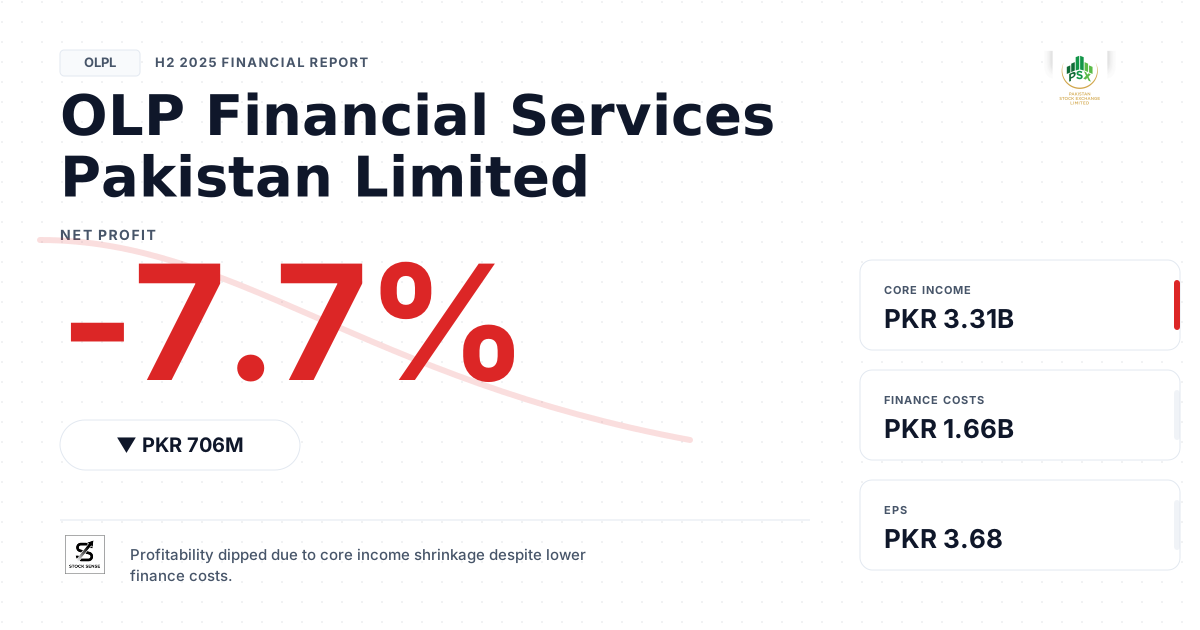
OLP Financial Services Pakistan Limited (OLPL) has reported a decline in its half-year profit for the period ended December 31, 2025. This downturn was primarily driven by a significant reduction in core operational income and other income, even as the company managed to achieve a substantial decrease in finance costs. The results translate into lower earnings per share for investors.
Financial Performance
OLPL's core revenue stream, 'Income from operations' (comprising mark-up on finance leases, loans, and finances), saw a notable decline of approximately 13.3%, falling from PKR 3.82 billion in the prior half-year to PKR 3.31 billion. 'Other income' also experienced a significant contraction, dropping by about 35.8% from PKR 926 million to PKR 594 million. Consequently, total income for the period decreased by 17.6%.
Despite this top-line pressure, the company managed to reduce its finance costs by a significant 28.8%, from PKR 2.34 billion to PKR 1.66 billion. This helped cushion the impact on the bottom line, but consolidated profit for the period still decreased by 7.7% to PKR 706 million from PKR 765 million. Profit attributable to equity holders also fell from PKR 691 million to PKR 646 million.
This translated into a lower Earnings Per Share (EPS) of PKR 3.68, down from PKR 3.94 in the comparative period. The profit before tax margin actually improved to around 29% from 25.5% in the prior half-year, highlighting the positive impact of finance cost management against a challenging revenue environment.
On the cash flow front, OLPL showed an improved operating cash outflow, reducing it from PKR 1.67 billion to PKR 1.26 billion. Net cash from investing activities turned positive at PKR 363 million, a significant turnaround from a PKR 2 billion outflow previously, primarily driven by a dramatic reduction in capital expenditure on ijarah finance, which significantly outweighed the impact of lower overall proceeds from asset disposals. The balance sheet shows a modest increase in total assets to PKR 45.88 billion from PKR 43.95 billion (as of June 30, 2025), while total equity remained relatively stable at PKR 11.98 billion.
Key Drivers & Segments
The primary drag on performance was the substantial reduction in mark-up on finance leases, which plunged by over 30.3% from PKR 1.03 billion to PKR 719 million. Mark-up on loans and finances also saw a 7.2% dip, contributing to the overall decline in operational income.
A key positive was the significant 28.8% reduction in finance costs, dropping from PKR 2.34 billion to PKR 1.66 billion. This suggests effective debt management or a favorable interest rate environment, which helped mitigate the impact of falling revenues. However, the reversal of expected credit loss provision was lower at PKR 28.1 million compared to PKR 64.4 million, indicating a higher net expense related to potential credit defaults, which partially offset the gains from lower finance costs.
Management Actions & Strategic Signals
The financial statements do not contain explicit commentary from management regarding future guidance or strategic initiatives. However, the notable reduction in finance costs points towards active liability management by the company.
A significant shift was observed in capital expenditure for ijarah finance, which dramatically decreased from PKR 365 million in the prior half-year to just PKR 18.8 million. This could signal a strategic re-evaluation of new lease originations or a broader shift in investment priorities. No interim dividend declaration for the current half-year was disclosed in the announcement.
Investor Takeaway
For investors, the key concern is the sustained decline in OLPL's core operational income streams. While finance cost management is commendable, the company's ability to reignite revenue growth in its primary segments will be paramount for future profitability.
The positive shift in investing cash flows, driven primarily by lower ijarah capex, bears watching to understand if this is a temporary adjustment or a longer-term strategic pivot towards different business lines or asset utilization. The lower EPS and absence of an interim dividend signal potential pressure on shareholder returns.
Investors should closely monitor upcoming quarterly reports for signs of revenue stabilization or growth, and any clarity on management's strategy to address the top-line challenges and improve credit quality. The company's ability to leverage its reduced finance costs to drive bottom-line growth will be critical in the coming periods.