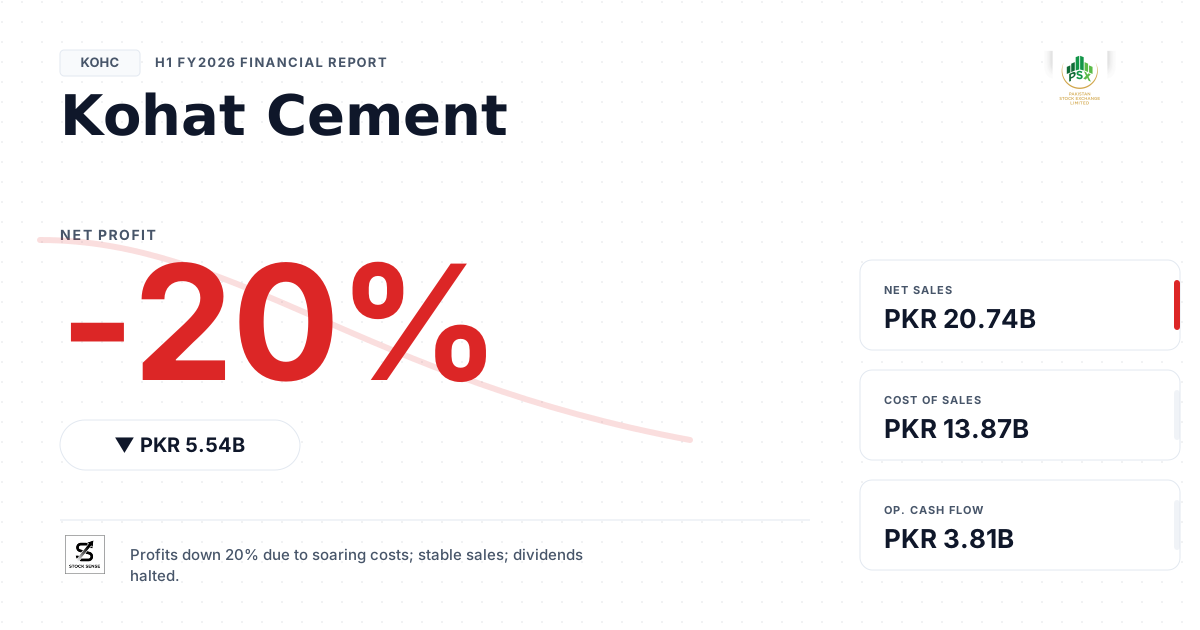
Kohat Cement Company Limited (KOHC) has reported a challenging first half of fiscal year 2026, with consolidated profits after tax declining by nearly 20% to PKR 5.54 billion, compared to PKR 6.88 billion in the same period last year. This significant drop, reflected in a lower Earnings Per Share (EPS) of PKR 6.03 (vs. PKR 7.03), is primarily due to a sharp increase in the cost of sales, eroding the company's profitability despite relatively stable revenue. (Source: Consolidated Condensed Interim Statement of Profit or Loss)
Financial Performance Overview
Consolidated net sales for the six months ended December 31, 2025, remained largely flat at PKR 20.74 billion, a marginal increase from PKR 20.66 billion in H1 2024. However, for the second quarter alone (Oct-Dec 2025), sales saw a slight dip to PKR 10.46 billion from PKR 10.58 billion in Q2 2024. (Source: Consolidated Condensed Interim Statement of Profit or Loss)
The unexpected element here is the substantial rise in cost of sales. For H1 2025, consolidated cost of sales jumped to PKR 13.87 billion from PKR 11.88 billion in H1 2024, an increase of over 16.6%. This squeezed the gross profit margin from approximately 42.5% to 33.1%. Consequently, gross profit fell by over 21.6% to PKR 6.88 billion. Operating profit also saw a similar decline of over 23% to PKR 5.96 billion. (Source: Consolidated Condensed Interim Statement of Profit or Loss)
Other income decreased from PKR 3.06 billion to PKR 2.62 billion. A positive note is the significant reduction in finance costs, which dropped by over 60% from PKR 209.8 million to PKR 82.1 million, providing some relief to the bottom line. Despite the lower finance costs, the overall impact of higher input costs and reduced other income led to the nearly 20% decline in net profit and EPS. (Source: Consolidated Condensed Interim Statement of Profit or Loss)
Consolidated operating cash flow for H1 2025 was PKR 3.81 billion, a substantial decrease of nearly 49.3% from PKR 7.52 billion in H1 2024, indicating significantly less cash generation from core operations. (Source: Consolidated Condensed Interim Statement of Cash Flows)
Total consolidated assets grew to PKR 76.41 billion as of December 31, 2025, from PKR 66.79 billion in June 2025. This growth was partly funded by a significant increase in long-term secured financing, which more than doubled from PKR 1.45 billion to PKR 3.29 billion. Property, plant, and equipment also increased by about PKR 2.98 billion, signaling ongoing capital expenditure. (Source: Consolidated Condensed Interim Statement of Financial Position)
Key Drivers & Strategic Implications
The primary driver behind the profit contraction appears to be the escalation in input costs, as evidenced by the sharp rise in cost of sales relative to stable revenue. This suggests persistent pressure on raw material prices, energy costs, or other operational expenses in the cement manufacturing process. The decline in 'Other Income' also contributed to the reduced overall profitability, highlighting a dual challenge for KOHC. (Source: Consolidated Condensed Interim Statement of Profit or Loss)
Management Actions & Shareholder Returns
The increase in Property, Plant & Equipment by approximately PKR 2.98 billion during the six-month period indicates that Kohat Cement is actively investing in its assets, likely for capacity expansion or modernization. The substantial increase in long-term secured financing suggests that these capital expenditures are being partly funded through debt. While this can support future growth, it also adds to the company's leverage. (Source: Consolidated Condensed Interim Statement of Financial Position)
Crucially for investors, the Board of Directors has recommended NIL cash dividend, bonus shares, or right shares for the quarter ended December 31, 2025. This decision, likely influenced by the lower profitability and ongoing capital investment, signals a focus on reinvesting earnings into the business rather than distributing them to shareholders at this time. (Source: Company Announcement, February 25, 2026)
Investor Takeaway: Navigating Cost Pressures and Growth Investments
The core concern for investors is the significant erosion of profitability due to rising costs. While sales remained resilient, the inability to effectively pass on increased costs or manage them has severely impacted the bottom line. The company is clearly in an investment phase, as evidenced by increased capital expenditure and debt. Investors need to carefully weigh this growth strategy against the immediate impact on shareholder returns, particularly the absence of dividends.
Investors should closely monitor future trends in input costs (especially energy and raw materials), the company's ability to improve pricing power, and the operational efficiency gains from recent investments. The market will be keen to observe if the current cost pressures are temporary or represent a more structural challenge for the cement sector. The next few quarters will be critical to determine if margins can recover and if the investments begin to translate into improved earnings and shareholder value.