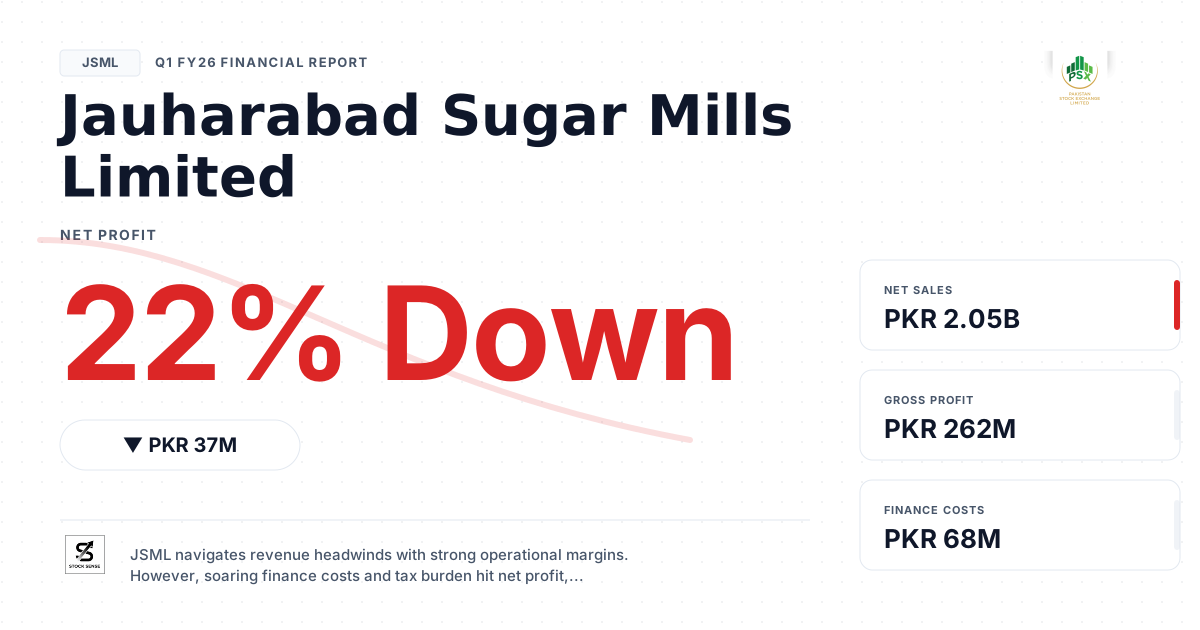
Jauharabad Sugar Mills Limited (JSML) has reported a mixed set of financial results for the first quarter ended December 31, 2025 (Q1 FY26). While the company experienced a notable decline in revenue, it demonstrated impressive operational efficiency, leading to significantly improved gross and operating margins. However, a sharp increase in finance costs and a significant swing from a tax credit to a tax expense ultimately weighed down the net profit, resulting in a lower earnings per share for the period. The board has not recommended any dividends or bonus shares, signaling a conservative approach.
Financial Performance Overview
Net sales for Jauharabad Sugar Mills Limited (JSML) in Q1 FY26 reached PKR 2.05 billion, marking a significant 26% decline from PKR 2.77 billion reported in the corresponding quarter of the previous year (Q1 FY25). This substantial top-line contraction points to potential challenges in sales volume or pricing power within the competitive sugar market.
Despite the revenue dip, the company showcased remarkable operational strength. Gross profit surged by 40% to PKR 262 million from PKR 187 million in Q1 FY25. This translated into a substantial improvement in gross profit margin, climbing from 6.7% to an impressive 12.8%. Operating profit also saw a healthy 39% increase, reaching PKR 177 million, with the operating margin expanding from 4.6% to 8.6%. This indicates effective cost management or a more favorable product mix at the operational level, even as total operating expenses (administrative and distribution costs) rose by 44% from PKR 59.06 million to PKR 85.23 million.
However, the positive operational performance did not fully translate to the bottom line. Profit after taxation decreased by 22% to PKR 37 million, down from PKR 47 million in Q1 FY25. Consequently, earnings per share (EPS) declined from PKR 1.38 to PKR 1.07. This was primarily due to three factors: a nearly 20% increase in finance costs to PKR 68 million (from PKR 57 million previously), reflecting higher borrowing costs; a significant swing in taxation from a PKR 13.9 million tax credit in Q1 FY25 to a PKR 32.4 million tax expense in Q1 FY26; and a 12.3% increase in 'Levy' from PKR 32.55 million to PKR 36.56 million.
On the balance sheet, total assets grew by 10.1% from PKR 15.36 billion at September 30, 2025, to PKR 16.91 billion by December 31, 2025. A notable change was the doubling of stock-in-trade from PKR 1.15 billion to PKR 2.31 billion, indicating a significant inventory build-up. Short-term borrowings also saw a substantial increase of over 55%, rising from PKR 2.84 billion to PKR 4.41 billion, likely to finance this inventory and other working capital needs. Cash and bank balances also more than doubled to PKR 932 million from PKR 397 million, providing some liquidity.
The cash flow statement reveals a significant net cash outflow from operating activities of PKR 881 million in Q1 FY26, a stark contrast to the PKR 58 million inflow in the prior year. This substantial outflow is largely attributable to the significant increase in inventory.
Key Operational Drivers
While the condensed financial statements do not provide segment-specific details, the improved gross and operating margins, despite lower sales, suggest several possibilities:
- Enhanced production efficiencies or better cost control measures within the sugar manufacturing process.
- Potentially more favorable raw material (sugarcane) procurement prices during the crushing season compared to the previous year.
- A shift towards higher-margin products or better recovery rates from the sugarcane processed.
The substantial increase in stock-in-trade could be a strategic move to build inventory ahead of anticipated demand or a consequence of slower-than-expected sales, which would need further clarification from management.
Management Actions & Strategic Signals
Capital expenditure remained consistent, with additions to fixed assets around PKR 77 million, indicating ongoing maintenance or minor expansion activities. The significant increase in short-term borrowings is a key management decision, likely aimed at financing the substantial inventory build-up and other working capital requirements. The board's decision to recommend NIL for cash dividend, bonus shares, and right shares signals a conservative approach, prioritizing internal financing and balance sheet management over immediate shareholder payouts, despite recording a profit.
Investor Takeaway
JSML's Q1 FY26 results present a nuanced picture for investors. The company demonstrated commendable operational resilience by significantly improving its gross and operating margins in a challenging revenue environment. This suggests a strong underlying business capable of managing costs effectively.
However, the impact of rising finance costs, the increasing 'Levy', and the swing to a tax expense cannot be overlooked, as they significantly eroded the net profit. Investors should closely monitor the following:
- Revenue Growth: Can JSML reverse the sales decline in upcoming quarters? Market conditions for sugar will be crucial.
- Margin Sustainability: Will the improved gross and operating margins hold, or were they a one-off due to specific market conditions?
- Operating Expense Control: Despite strong gross margins, operating expenses (administrative and distribution) rose significantly. Can JSML control these costs in future periods?
- Finance Cost Management: With interest rates remaining high, how will the company manage its increased short-term borrowings and associated finance costs?
- Working Capital Efficiency: The large inventory build-up and increased debt warrant close attention. How will this impact future cash flows and profitability?
- Taxation Policy & Levy: Understanding the factors behind the significant shift in taxation and the increasing 'Levy' will be important for projecting future earnings.
- Payout Policy: The absence of dividends indicates a focus on reinvestment or debt management. Income-focused investors might find this disappointing.
In essence, JSML is showing signs of strong operational execution, but external factors like market demand, interest rates, and tax policies are currently challenging its bottom line. Investors should look for sustained operational improvements combined with better top-line performance and controlled financing costs in future reports to confirm a positive trajectory.