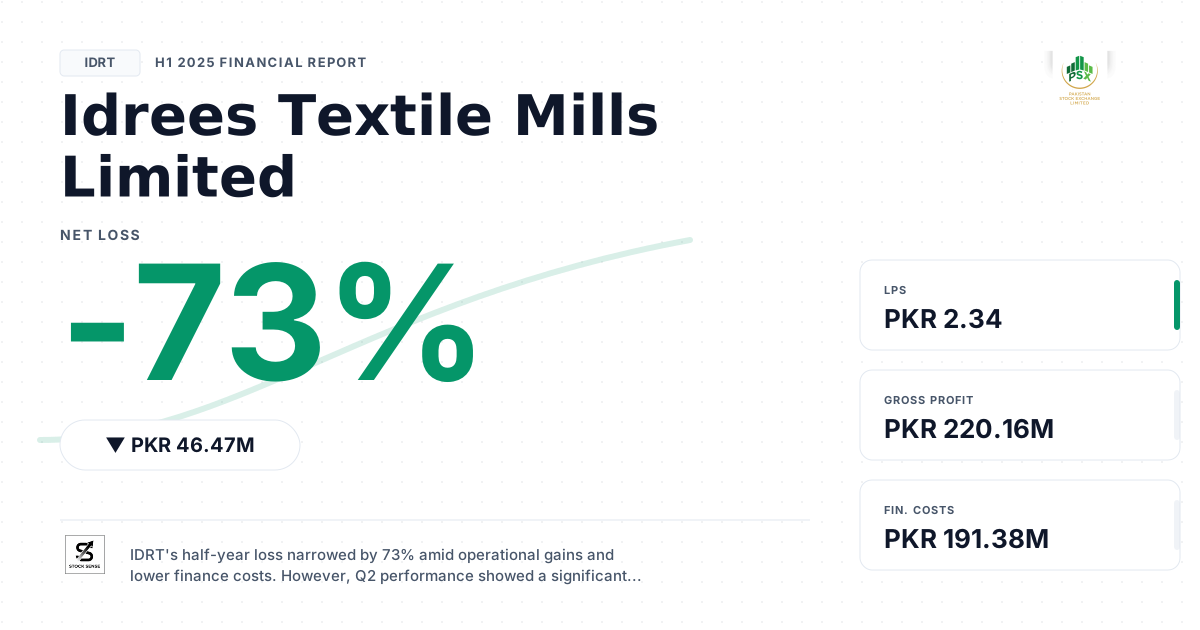
Idrees Textile Mills Limited (IDRT) has reported a substantial 73.01% reduction in its consolidated net loss for the half-year ended December 31, 2025. This significant improvement, driven by enhanced operational efficiency and lower finance costs, marks a positive shift from the previous year. However, a closer examination of the second quarter (October-December 2025) reveals a concerning reversal, with the company posting a significantly higher loss compared to the same quarter last year.
Financial Performance Highlights
For the half-year, IDRT's consolidated net loss dramatically narrowed by 73.01%, from PKR 172.19 million in H1 2024 to PKR 46.47 million in H1 2025. This significant turnaround translated into a much lower loss per share of PKR 2.34, a stark improvement from PKR 8.67 previously. Despite a 13.29% decline in net sales to PKR 2.15 billion (from PKR 2.48 billion in H1 2024), IDRT managed to boost its gross profit by 8.94% to PKR 220.16 million. This indicates a notable improvement in gross margins, rising from 8.15% to 10.23%, suggesting better cost management or a more favorable product mix. Operating profit also saw a healthy 21.62% increase, reaching PKR 144.71 million.
A pivotal factor in the reduced losses was a significant 29.66% decrease in finance costs, which fell from PKR 272.08 million in H1 2024 to PKR 191.38 million in H1 2025. This reduction is particularly crucial in the prevailing high-interest rate environment. On the balance sheet, total assets expanded from PKR 7.65 billion as of June 30, 2025, to PKR 8.14 billion as of December 31, 2025. This growth was accompanied by an increase in current assets, notably trade debts (up PKR 370.11 million) and stock-in-trade (up PKR 39.64 million), reflecting higher working capital requirements. Critically, consolidated net cash used in operating activities improved significantly, decreasing from PKR 85.65 million in H1 2024 to PKR 27.17 million in H1 2025, indicating more efficient operational cash management.
However, the second quarter (October-December 2025) presents a more challenging picture. Sales dipped slightly by 1.42% to PKR 1.23 billion (from PKR 1.24 billion in Q2 2024). More concerning, gross profit saw a sharp 36.44% decline to PKR 106.92 million (from PKR 168.22 million), pulling gross margins down to 8.72% from 13.53% in Q2 2024. Consequently, the consolidated net loss for Q2 2025 more than doubled to PKR 28.78 million from PKR 13.82 million in Q2 2024, resulting in a higher loss per share of PKR 1.45 versus PKR 0.70.
Key Drivers & Segment Insights
The overall half-year improvement was primarily driven by:
- Enhanced gross margins, rising from 8.15% to 10.23% for the half-year, likely due to more efficient production or a favorable product mix, particularly in the first quarter.
- A substantial 29.66% reduction in finance costs, significantly easing the burden on the bottom line.
- Improved cost control, with distribution and administrative expenses collectively decreasing by 9.19% for the half-year.
The financial statements do not provide a breakdown by specific business lines or product segments, making it difficult to pinpoint exact drivers at a granular level.
Management Actions & Strategic Signals
The notable reduction in finance costs suggests active and effective debt management. While short-term borrowings increased by PKR 220.07 million (from PKR 2.06 billion to PKR 2.28 billion) between June 30, 2025, and December 31, 2025, the overall cost of debt appears to have been optimized, possibly through refinancing or a shift in borrowing mix. Capital expenditure on property, plant, and equipment was significantly lower at PKR 2.76 million in H1 2025, compared to PKR 13.22 million in the prior half-year, indicating a cautious approach to expansion and a focus on conserving capital. The financial results do not include any announcement regarding dividends for the period.
Investor Takeaway
IDRT's half-year results present a mixed but generally improving narrative. The company has demonstrated an ability to significantly reduce its losses through better operational efficiency and effective finance cost management. However, the deterioration in the most recent quarter (Q2 2025) compared to Q2 2024 is a point of concern, suggesting that the positive momentum from Q1 may be facing renewed challenges.
Investors should closely monitor:
- The sustainability of gross margin improvements, particularly given the sharp Q2 dip.
- The company's ability to effectively manage its finance costs amidst a volatile interest rate environment, especially with increased short-term borrowings.
- Any signs of revenue growth and a clear path towards sustained profitability in the coming quarters.
- Working capital management, as the significant increase in trade debts and stock-in-trade could impact liquidity.
While the overall trend for the half-year is positive, the recent quarterly performance indicates that a full turnaround to consistent profitability still requires careful observation.