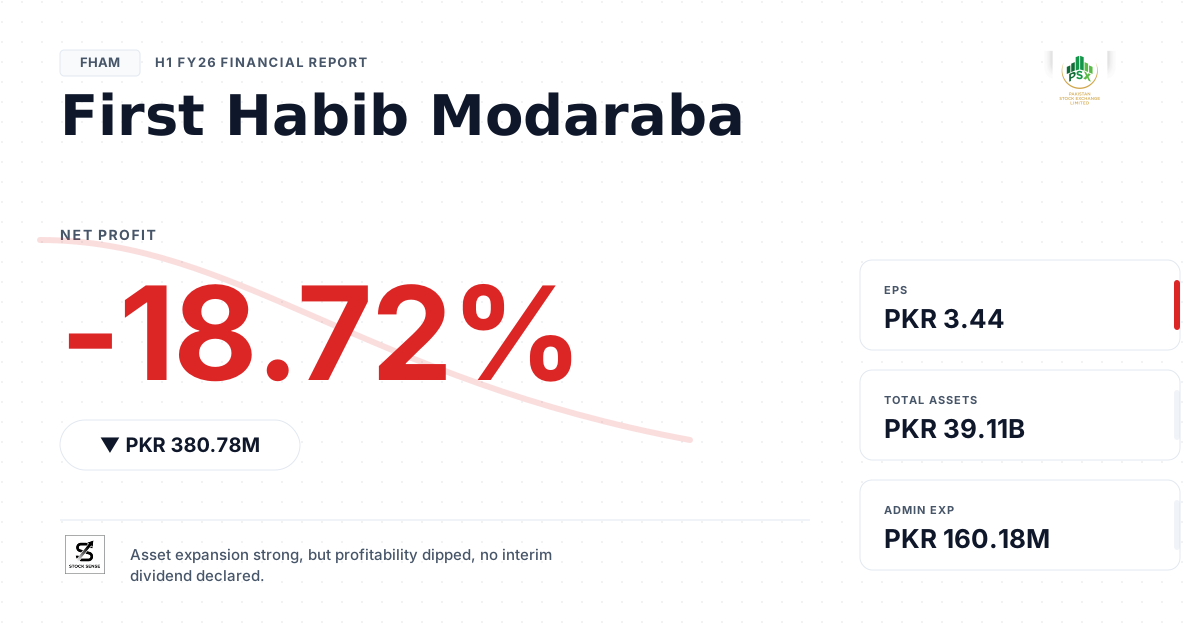
First Habib Modaraba (FHAM) has announced its financial results for the half-year ended December 31, 2025, presenting a mixed picture for investors. While the Modaraba significantly expanded its asset base, particularly in its core diminishing musharaka financing, this growth did not translate into improved profitability. Both top-line income from financing activities and net profit declined year-on-year. Crucially, the Board of Directors recommended no cash dividend, bonus shares, or right shares for the period, signaling a focus on capital retention.
Financial Performance: A Closer Look at Declining Profits
For the half-year ended December 31, 2025, FHAM reported a profit after taxation of PKR 380.78 million, a notable decrease of 18.72% compared to PKR 468.53 million in the same period last year. This decline was primarily driven by a fall in income from diminishing musharaka financing, which dropped by 14.67% to PKR 2.31 billion from PKR 2.71 billion previously. Earnings per certificate (EPS) followed suit, decreasing from PKR 4.23 to PKR 3.44.
On a quarterly basis (Q2 FY26 vs Q2 FY25), the trend was even more pronounced, with profit after taxation plummeting by 29.64% to PKR 195.78 million from PKR 278.27 million, and EPS falling from PKR 2.51 to PKR 1.77. While financial charges decreased by 14.31% year-on-year, administrative expenses saw a significant increase of 27.42% to PKR 160.18 million, further impacting the bottom line.
Strategic Asset Expansion and Funding
Despite the dip in profitability, FHAM's balance sheet demonstrates robust growth. Total assets expanded by 12.56% to PKR 39.11 billion as of December 31, 2025, from PKR 34.75 billion on June 30, 2025. This expansion was largely fueled by a substantial increase in diminishing musharaka financing, the Modaraba's primary business, which grew by 13.41% to PKR 34.94 billion.
The corresponding increase in liabilities, specifically 'Certificates of investment (musharaka)' by 11.71% to PKR 23.21 billion and 'Running musharaka' by 24.61% to PKR 7.84 billion, highlights the company's strategy to fund its asset growth through these Islamic financing instruments.
Operational Headwinds and Management's Stance
The decline in income from the diminishing musharaka segment, despite significant portfolio growth, suggests potential operational challenges. These could include competitive pressures, changes in financing rates, or the timing of income recognition from new deployments. Coupled with the notable rise in administrative expenses, these factors have squeezed the Modaraba's margins.
The most immediate signal from management is the decision to not declare any cash dividend, bonus shares, or right shares for this half-year period. This suggests a prudent focus on retaining earnings to support the ongoing expansion of the financing portfolio or to strengthen the capital base amidst a challenging profit environment. Positively, cash flow from investing activities turned positive, generating PKR 128.90 million compared to a usage of PKR 95.18 million in the prior year, indicating more efficient asset management or strategic divestments.
Investor Outlook: Navigating Growth and Profitability Challenges
For investors, FHAM's latest results present a mixed bag. The robust growth in the asset base, particularly in musharaka financing, signals continued expansion and market presence. However, the inability to translate this growth into higher profitability, coupled with rising administrative expenses, is a point of concern. The absence of an interim dividend, while potentially disappointing for some shareholders, can be interpreted as a strategic move to bolster the company's financial position for future growth.
Rational investors should closely monitor FHAM's ability to improve its income generation from the expanded musharaka portfolio in the coming quarters. Key areas to watch include trends in financing rates, effective cost management (especially administrative expenses), and the eventual dividend policy for the full year. The current period appears to be one of investment and consolidation, laying groundwork for future potential, rather than immediate profit realization for shareholders.