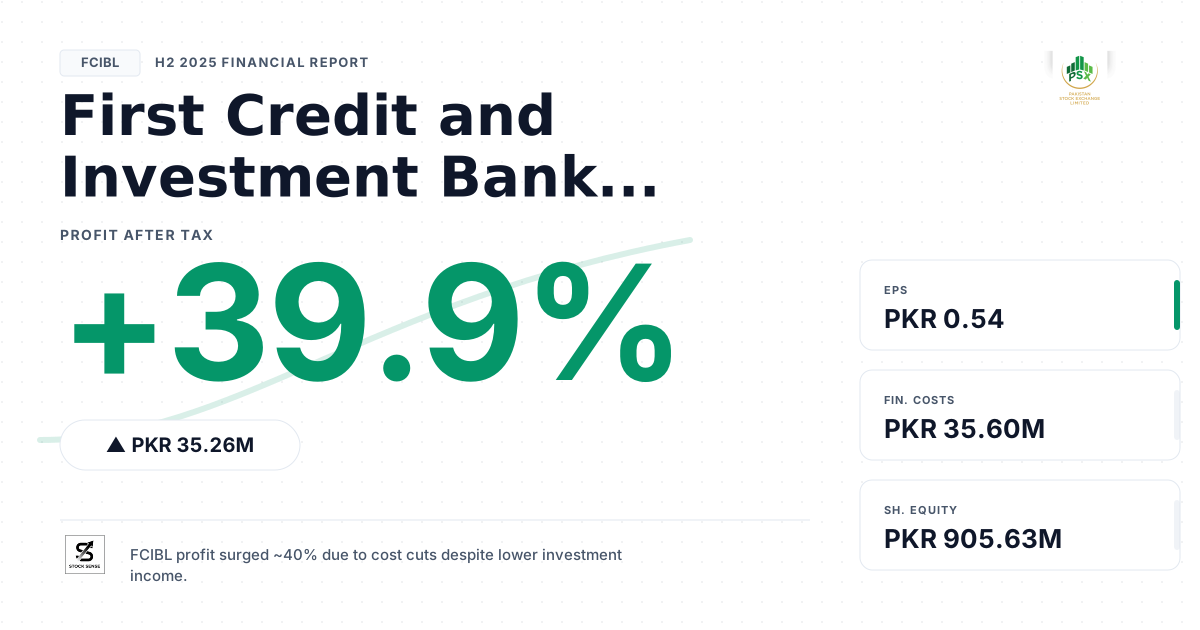
First Credit and Investment Bank Limited (FCIBL) has reported a remarkable financial turnaround for the half-year ended December 31, 2025. Profit after tax soared by nearly 40% year-on-year, primarily propelled by an extraordinary 87% reduction in finance costs. This impressive bottom-line growth occurred despite a significant decline in investment income, signaling a strategic reorientation. The Board's recommendation of no cash dividend, bonus, or right shares indicates a clear focus on strengthening internal capital.
Robust Profitability Driven by Cost Efficiency
For the six months ending December 31, 2025, FCIBL's profit after taxation surged to PKR 35.26 million, a substantial increase from PKR 25.21 million in the prior year. This translates to an Earnings Per Share (EPS) of PKR 0.54, a healthy jump from PKR 0.39, reflecting improved per-share earnings.
Total income contracted sharply to PKR 127.09 million from PKR 348.41 million, largely due to significantly lower income from investments (PKR 85.42 million vs. PKR 302.33 million). However, strategic cost management proved pivotal: finance costs plummeted by 87.2% from PKR 278.15 million to just PKR 35.60 million, becoming the primary catalyst for boosted profitability.
Administrative and operating expenses saw a modest 12.39% increase to PKR 55.94 million. Concurrently, FCIBL's total assets expanded to PKR 4.43 billion from PKR 4.11 billion six months prior, and Shareholders' equity strengthened to PKR 905.63 million from PKR 875.47 million, reflecting retained earnings.
Dramatic Investment Portfolio Rebalancing
A significant strategic repositioning of the investment portfolio is evident. Long-term investments were drastically reduced from PKR 3.06 billion (June 30, 2025) to PKR 173.86 million (December 31, 2025). Concurrently, short-term investments soared from PKR 276.72 million to PKR 3.58 billion, signaling a move towards greater liquidity and a more agile, opportunistic short-term asset allocation strategy.
Intriguingly, this substantial reduction in finance costs occurred despite an increase in short-term borrowings, which rose from PKR 3.19 billion to PKR 3.48 billion. This suggests cost savings were not due to reduced borrowing volume but rather to factors like a favorable interest rate environment, renegotiated terms, or highly efficient treasury management. This unexpected outcome highlights a key area of operational strength.
Cash Flow Dynamics and Management's Stance
Operating cash flow decreased significantly to PKR 130.26 million for the half-year, compared to PKR 347.21 million in the prior year. Meanwhile, the investment portfolio rebalancing led to a net cash outflow of PKR 592.22 million from investing activities, a stark contrast to the PKR 238.61 million generated previously. This outflow directly reflects the strategic shift from long-term to short-term assets.
The Board's decision to recommend no cash dividend, bonus, or right shares, despite improved profits, underscores management's prioritization of capital preservation and internal reinvestment. This strategy is likely aimed at strengthening the balance sheet and funding future growth without external dilution.
Investor Outlook: Monitoring Strategic Shifts
FCIBL's ability to achieve significant bottom-line improvement through effective cost management, particularly in finance costs, is a positive indicator. The improved EPS suggests a healthier earnings trajectory. However, the dramatic overhaul of the investment portfolio is a critical development. Investors should closely monitor the performance of this newly structured short-term investment base and seek further clarity from management on the rationale behind this pivot and its expected impact on future income generation and risk profile. While the absence of dividends might temper enthusiasm for income-focused investors, it simultaneously signals a commitment to bolstering the company's financial foundation. The sustainability of lower finance costs and future indications regarding capital deployment and shareholder returns will be key areas to watch in upcoming financial reports.