Engro Powergen Qadirpur Limited (EPQL) has announced its financial results for the year ended December 31, 2025, showcasing a significant decline in profitability but an unexpected surge in dividend payout, largely underpinned by a substantial resolution of circular debt. While earnings per share fell, the company's improved liquidity position and commitment to shareholder returns stand out.
Financial Performance Highlights
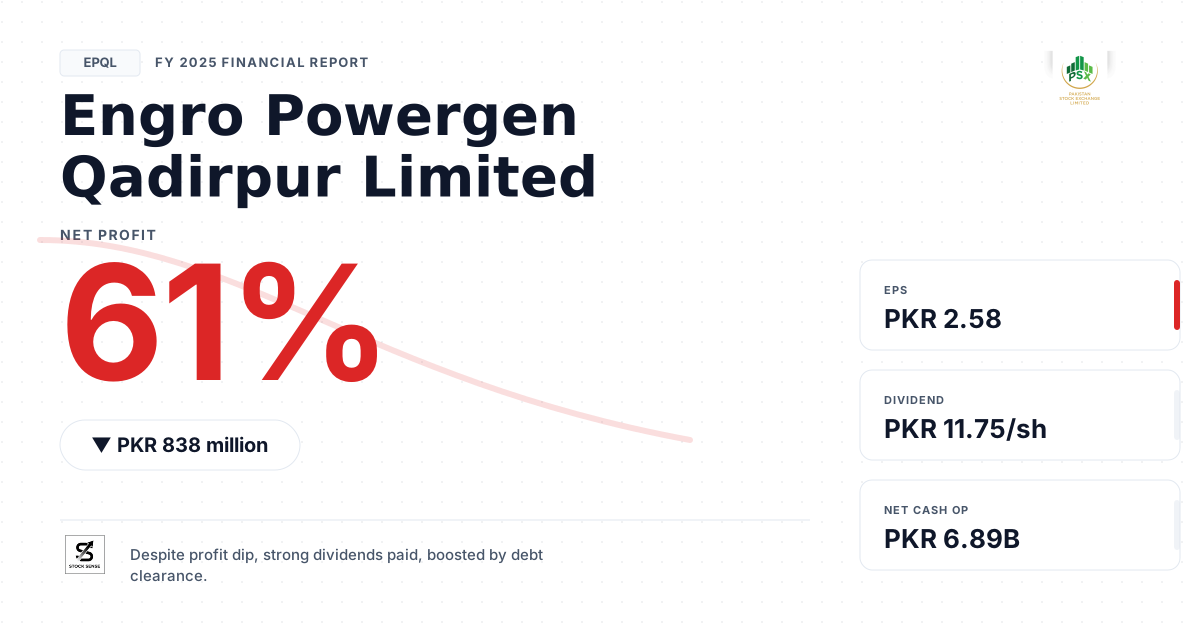
EPQL experienced a challenging year financially. Sales revenue for 2025 was recorded at PKR 11,889 million, a notable decrease from PKR 13,250 million in 2024. This 10% dip trickled down to the bottom line, with gross profit falling sharply to PKR 1,314 million from PKR 2,800 million in the previous year, representing a 53% reduction. Consequently, net profit for the year plummeted by 61% to PKR 838 million compared to PKR 2,141 million in 2024, resulting in earnings per share (EPS) of PKR 2.58, down from PKR 6.61.
Despite the lower earnings, EPQL declared a substantial total cash dividend of PKR 11.75 per share for 2025 (comprising a final dividend of PKR 1.25 and interim dividends of PKR 10.50). This payout significantly exceeds the year's EPS, signaling a strong commitment to shareholders, likely facilitated by improved cash flows from the resolution of long-standing circular debt issues. The company's net cash generated from operating activities saw a remarkable increase to PKR 6.89 billion in 2025, up from PKR 3.27 billion in 2024, reflecting this enhanced liquidity.
The balance sheet reflects a healthier liquidity position. Overdue receivables from the power purchaser, a major concern for Independent Power Producers (IPPs), were drastically reduced from PKR 6.6 billion at the end of 2024 to PKR 1.0 billion as of December 31, 2025. This improvement was due to a significant bullet payment of PKR 7.4 billion received in the first quarter of 2025, clearing most of the pending dues. Short-term borrowings also decreased from PKR 3.98 billion in 2024 to PKR 2.13 billion in 2025.
Key Performance Drivers
The decline in revenue and profitability was primarily driven by two factors:
- A major scheduled outage conducted during 2025, which impacted operational availability.
- A reduction in capacity payments due to the implementation of a hybrid 'take & pay' model in the power sector.
The company's net electrical output was 774 GWh with a load factor of 42% in 2025, slightly down from 45% in 2024, mainly due to the scheduled maintenance. However, EPQL maintained a 100% billable availability factor. A significant positive development was the government's intervention to tackle circular debt, which resulted in a PKR 7.4 billion bullet payment to EPQL in Q1 2025, substantially improving the company's cash position and reducing its trade debts.
Management's Strategic Outlook
Management is actively addressing the operational challenges. With the new 'Hybrid Take & Pay' model, cost control has become a critical focus, and the company has initiated cost optimization efforts to counter inflationary pressures. On the fuel supply front, EPQL is diligently working to secure additional indigenous gas options, including PEL gas, Kandhkot gas, and gas from Badar and Ibrahim fields. These efforts aim to enhance the plant's load factor, potentially increasing it from the current ~50% to up to 85%, which would significantly improve operational efficiency and competitiveness.
The company's high merit order position (ranked #10 with permeate gas and #13 with PEL gas) ensures it remains operational throughout the year, maintaining competitiveness against imported fuels despite the broader power sector's transition towards indigenous and renewable energy sources.
Investor Takeaway: A Balanced View
For investors, EPQL's 2025 results present a mixed picture. The sharp decline in profits and EPS is a concern, stemming from operational outages and changes in the power purchase agreement structure. However, the substantial dividend payout, far exceeding the year's earnings, is a clear signal of management's confidence and commitment to shareholders, made possible by the significant reduction in circular debt. This debt resolution has dramatically improved the company's liquidity and cash flow.
Going forward, rational investors should closely monitor EPQL's progress on securing additional gas supplies and their impact on the plant's load factor and overall profitability. The company's ability to increase its dispatch and optimize costs under the new hybrid model will be crucial. While the power sector faces challenges like decoupling demand from GDP growth, EPQL's high merit order position provides a defensive advantage. The improved balance sheet and strong dividend policy make EPQL an interesting watch for income-seeking investors, provided future earnings can stabilize or grow with the planned operational enhancements.