Chashma Sugar Mills Limited (CHAS) has reported a significantly widened loss for the financial year ended September 30, 2025, primarily driven by a substantial decline in sales, a sharp swing from operational profit to loss, and persistently high finance costs. This performance signals a challenging period for the company, with critical implications for its liquidity and long-term sustainability.
Financial Performance Overview
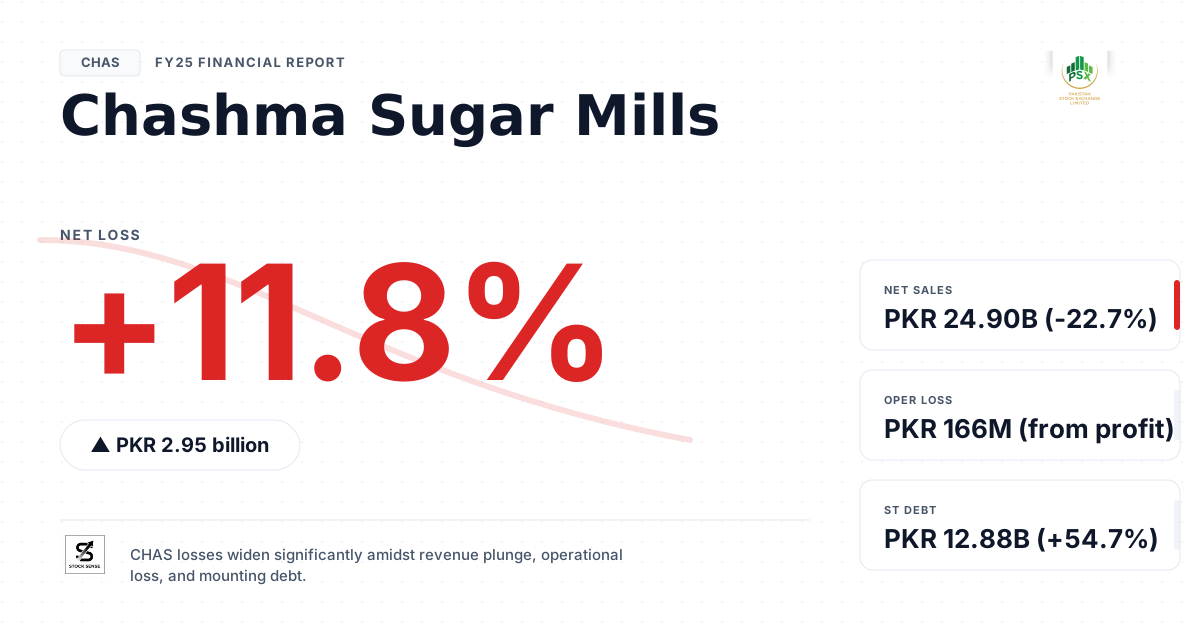
The company's net sales saw a significant 22.7% drop, falling to PKR 24.90 billion in FY25 from PKR 32.27 billion in FY24. This revenue contraction directly impacted gross profit, which decreased by 25.3% from PKR 2.22 billion to PKR 1.66 billion, with a slight compression in gross margin from 6.88% to 6.67%. More critically, the company's operations swung from a profit of PKR 285 million in FY24 to an operating loss of PKR 166 million in FY25. This operational decline occurred despite a notable 127.5% increase in 'Other Income' to PKR 992 million (from PKR 436 million in FY24), which provided a partial offset.
Selling and distribution expenses surged by 32.3% to PKR 1.16 billion, and administrative and general expenses increased by 24.6% to PKR 1.49 billion. This significant rise in operating costs, disproportionate to the revenue decline, indicates potential challenges in cost control and operational efficiency. Despite a reduction of 18.3% from PKR 4.10 billion to PKR 3.35 billion, finance costs remained a massive burden, representing the largest expense after cost of sales and continuing to erode profitability. Consequently, the net loss for the year expanded by 11.8% to PKR 2.95 billion, up from PKR 2.64 billion in FY24, leading to a worsened loss per share of PKR (102.77) compared to PKR (91.92) previously.
On the balance sheet, total equity declined by 22.3% from PKR 13.14 billion to PKR 10.21 billion due to the accumulated losses. A major red flag is the surge in short-term borrowings, which jumped by 54.7% from PKR 8.33 billion to PKR 12.88 billion, indicating increased reliance on debt for working capital. Trade and other payables also saw a massive 189.0% increase to PKR 4.29 billion from PKR 1.48 billion, further straining working capital. Cash flow from operations turned sharply negative, moving from a generation of PKR 1.53 billion in FY24 to a usage of PKR 1.12 billion in FY25, highlighting severe internal cash generation issues.
Key Drivers & Challenges
While the financial statements do not provide granular segment details, several factors appear to be key drivers of CHAS's performance:
- Revenue Contraction: The significant 22.7% decline in net sales suggests a challenging market environment or reduced production/sales volumes for its core sugar business.
- Escalating Operating Costs: The disproportionate increase in selling, distribution, and administrative expenses, even with lower sales, points to a high fixed cost base or inefficiencies that are difficult to manage.
- High Finance Costs: Despite an 18.3% reduction, the substantial finance expense of PKR 3.35 billion continues to be a primary drag on profitability, reflecting a significant debt burden and potentially high interest rates.
- Working Capital Strain: A substantial 78.1% increase in stock-in-trade to PKR 7.10 billion (from PKR 3.99 billion) indicates inventory buildup, tying up significant capital and contributing to the surge in short-term borrowings.
- Asset Sales for Liquidity: The positive cash flow from investing activities, largely driven by PKR 3.91 billion from the sale of operating fixed assets, indicates the company is divesting assets, likely to manage liquidity in the face of negative operating cash flows.
Management Actions & Strategic Signals
The significant increase in short-term borrowings and trade payables suggests management is actively navigating severe liquidity challenges, likely through increased reliance on short-term credit. The substantial sale of fixed assets, generating PKR 3.91 billion, provided a critical but temporary boost to cash from investing activities, directly offsetting the negative operating cash flow. This raises serious questions about the long-term asset base, future operational capacity, and the sustainability of such a strategy. No explicit guidance or forward-looking statements regarding future strategies, expansions, or debt restructuring were disclosed in this announcement. The company's heavy and growing short-term debt signals an urgent need for comprehensive strategic financial management.
Investor Takeaway
Chashma Sugar Mills is currently in a precarious position. The widening losses, declining revenue, the alarming shift to negative operating cash flow, and the massive increase in short-term liabilities are significant concerns for investors. The reliance on asset sales to generate cash, while providing immediate relief, is not a sustainable long-term strategy for growth. The surge in short-term debt further compounds the financial risk.
Rational investors should closely monitor several key areas going forward:
- Revenue Reversal: Can the company stem the decline in sales and achieve sustainable revenue growth?
- Cost Control: What measures will management implement to control escalating operating expenses and improve operational efficiency?
- Debt Management: How will the company address its substantial finance costs and restructure its mounting short-term debt?
- Operational Cash Flow: A sustained return to positive cash flow from operations is critical for the company's viability.
- Working Capital Management: How will the company manage its increasing inventory and trade payables to reduce reliance on short-term debt?
- Future Strategy: Any indications of a clear turnaround strategy, including potential capital expenditure plans or further asset disposals, will be crucial.
Given the current results, CHAS presents a high-risk profile, and investors should exercise extreme caution and await concrete signs of operational and financial improvement before considering new positions.