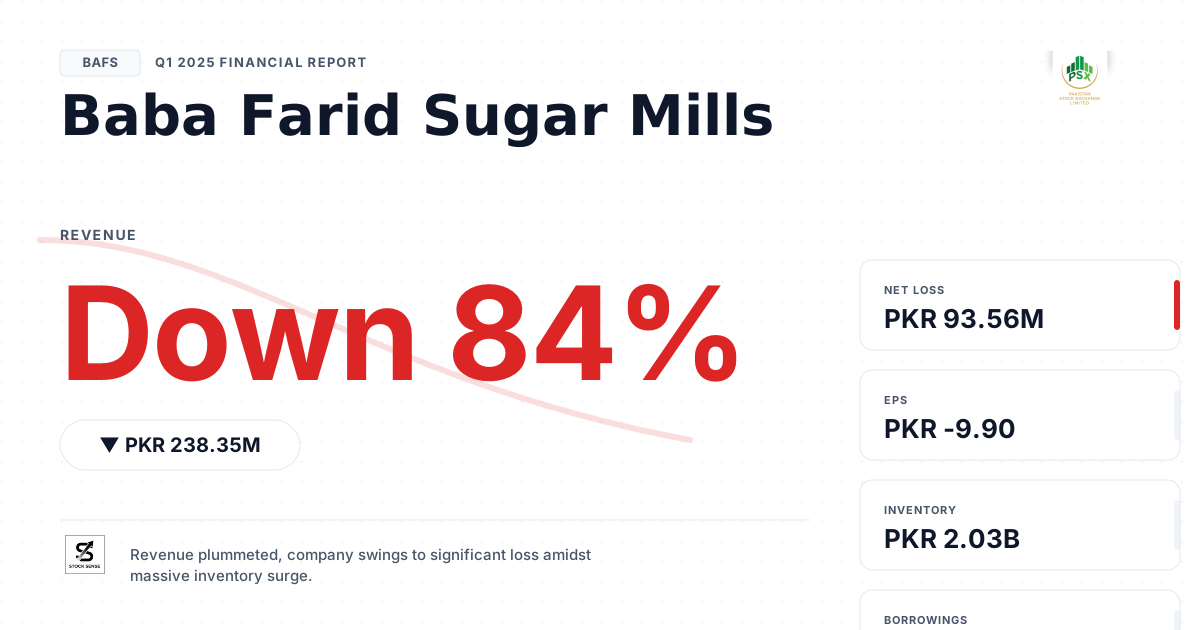
Baba Farid Sugar Mills Limited (BAFS) has reported a challenging first quarter ended December 31, 2025, with a dramatic decline in revenue and a substantial swing from profit to loss. The results indicate significant operational headwinds, marked by a sharp reduction in sales and a concerning buildup of inventory, which has necessitated a substantial increase in short-term borrowings.
Financial Performance Overview
The company's revenue from contracts with customers plummeted by approximately 84%, falling to PKR 238.35 million in Q1 2025 from PKR 1.48 billion in the same period last year. This drastic reduction in top-line sales directly impacted profitability, turning a gross profit of PKR 222.43 million in Q1 2024 into a gross loss of PKR 44.24 million this quarter.
Consequently, BAFS recorded an operating loss of PKR 70.82 million, a stark contrast to the operating profit of PKR 150.72 million reported in Q1 2024. Despite a significant 84% reduction in financial charges (from PKR 121.18 million in Q1 2024 to PKR 19.40 million in Q1 2025) and a notable increase in other income, the company posted a net loss of PKR 93.56 million for the quarter, compared to a net profit of PKR 12.41 million in Q1 2024. This translates to a negative Earnings Per Share (EPS) of PKR 9.90, a sharp decline from a positive EPS of PKR 1.31 year-on-year.
On the balance sheet, a critical development is the massive increase in 'Stock in trade' (inventory), which surged from PKR 84.88 million as of September 30, 2025, to PKR 2.03 billion (PKR 2,025.86 million) by December 31, 2025 – an increase of over 2,286%. This substantial inventory buildup significantly boosted current assets. However, it simultaneously led to a dramatic rise in current liabilities, primarily driven by short-term borrowings, which soared from PKR 104.77 million to PKR 1.62 billion (PKR 1,621.68 million) over the same period, indicating a substantial increase in debt reliance to finance working capital.
Cash flow from operating activities worsened considerably, with net cash used in operations escalating to PKR 1.66 billion (PKR 1,661.07 million) in Q1 2025, a significant increase from PKR 294.92 million used in the prior year's quarter. This reflects severe challenges in managing working capital amidst drastically lower sales and the massive inventory accumulation.
Key Drivers & Segments
The primary driver for this quarter's poor performance is the sharp decline in sales revenue. While specific segment details are not provided in this announcement, for a sugar mill, this typically points to either:
- Significantly lower sales volumes of sugar or by-products.
- Depressed selling prices for its products.
- A combination of both, alongside potentially higher production costs relative to sales.
The substantial increase in 'Stock in trade' suggests that the company produced goods that it could not sell at desired levels or prices during the quarter, leading to an inventory pile-up.
Management Actions & Strategic Signals
Capital expenditure during the quarter remained modest, with additions to operating fixed assets and capital work in progress totaling approximately PKR 37.04 million. The most significant management action observed is the substantial increase in short-term borrowings to finance the elevated inventory levels. This suggests a strategic decision to hold stock, potentially anticipating better future prices or sales demand. While this strategy aims to maximize future revenue, it introduces increased financial risk and potential future debt servicing costs, despite the current quarter showing a significant reduction in financial charges paid compared to the prior year.
No dividends were announced for the quarter, and the financial statements do not provide any explicit forward-looking guidance or strategic commentary from management.
Investor Takeaway
This quarter's results for Baba Farid Sugar Mills are deeply concerning for investors. The core takeaway is the severe deterioration in operational performance, marked by a significant revenue collapse and a swing to a substantial net loss. Rational investors should closely monitor several key aspects:
- Inventory Management: The massive inventory buildup is a double-edged sword. While it could lead to higher revenues if sold profitably in subsequent quarters, it ties up significant capital and exposes the company to price fluctuations and carrying costs. Investors should watch for inventory liquidation strategies and their impact on future margins.
- Debt Levels: The sharp increase in short-term borrowings to finance inventory raises significant concerns about liquidity and financial health. While financial charges for the current quarter were notably lower year-on-year, the ability to service this substantially increased debt, especially with negative operating cash flows, will be critical for future profitability.
- Market Conditions: As a sugar company, BAFS is highly susceptible to sugar cane availability, government policies, and international sugar prices. Investors need to assess if this quarter's performance is an isolated seasonal blip or indicative of broader, more persistent challenges in the sugar sector.
- Turnaround Prospects: Future quarters will be crucial to see if management can reverse the negative trends, reduce inventory efficiently, and return to profitability. The lack of dividend disclosure is also a point to note for income-focused investors.
Overall, BAFS faces a challenging period, and investors should exercise caution and seek further clarity on the drivers behind the revenue decline and inventory strategy.