AGSML's Q1 FY26: Widening Losses Despite Sales Growth, Operational Challenges Mount
Abdullah Shah Ghazi Sugar Mills Limited (AGSML) has reported its financial results for the first quarter ended December 31, 2025, revealing a concerning trend. While the company managed to increase its sales year-on-year, this growth failed to translate into profitability, with a significant widening of its net loss and a dramatic drop in operating cash flow.
Financial Performance Under Scrutiny
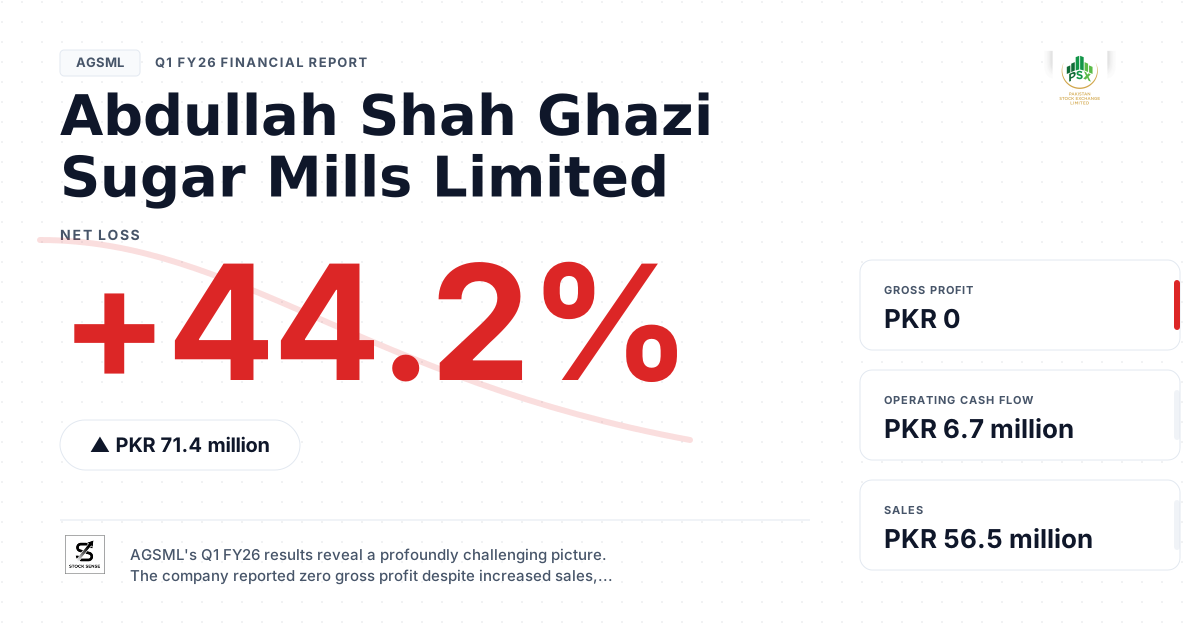
AGSML's sales for Q1 FY26 grew by approximately 21% to PKR 56.5 million, up from PKR 46.7 million in the same period last year. However, the most striking and concerning figure is the company's gross profit, which stood at zero. This indicates that the cost of sales exactly matched the revenue generated, leaving no margin to cover operating expenses – a critical red flag for any manufacturing entity.
Consequently, the company's net loss after taxation widened significantly to PKR 71.4 million for the quarter, compared to a loss of PKR 49.5 million in Q1 FY25. This translates to an increased loss per share of PKR 0.90, up from PKR 0.63 previously. While finance costs saw a modest 16.5% reduction, the complete erosion of gross profit and a substantial 87% surge in administrative expenses (from PKR 1.83 million to PKR 3.42 million) overwhelmed any positive impact.
Cash flow from operating activities, a crucial indicator of a company's health, plummeted from PKR 128.9 million in Q1 FY25 to just PKR 6.7 million in Q1 FY26. This substantial 95% decline signals a severe reduction in the company's ability to generate cash from its core business operations. On the balance sheet, accumulated losses continued to mount, reaching over PKR 2.82 billion as of December 31, 2025, further eroding shareholder equity.
Key Drivers & Operational Pressures
The primary driver behind the deteriorating profitability is the complete erosion of gross margins, resulting in zero gross profit despite higher sales. This suggests fundamental challenges in the company's production costs, pricing strategy, or inventory management. The financial statements do not provide segment-wise details, but the overall operational efficiency appears to be under significant pressure.
Additionally, 'Other Income,' which provided a cushion of PKR 14.9 million in the prior year, decreased by 31.6% to PKR 10.2 million, further contributing to the expanded net loss.
Management Actions & Strategic Signals
Capital expenditure was minimal at PKR 0.5 million, a sharp 99.6% reduction from PKR 134.2 million in the previous year's comparable quarter. This suggests a significant slowdown in investments in property, plant, and equipment, possibly due to financial constraints or a strategic pause. The company also made payments of PKR 5 million against long-term financing, indicating efforts to manage its debt obligations.
The Board of Directors recommended 'Nil' for cash dividends, bonus shares, right shares, and any other corporate entitlements. This decision underscores the company's current financial struggles and its focus on preserving capital rather than distributing returns to shareholders, a clear signal of caution to the market.
Investor Takeaway: A High-Risk Proposition
For investors, AGSML's Q1 FY26 results present a profoundly challenging picture. The core issue is the company's inability to generate any gross profit from its sales, which is a fundamental operational flaw for any manufacturing entity. This, coupled with widening net losses and significantly reduced operating cash flow, raises serious questions about the company's long-term viability and ability to sustain operations.
Rational investors should approach AGSML with extreme caution. Key areas to monitor include any explanations from management regarding the zero gross profit, concrete plans to improve operational efficiency and cost control, and strategies to reverse the trend of accumulating losses. Without a clear and credible path to sustainable profitability, the stock remains highly speculative, and traditional valuation metrics are difficult to apply, making it a high-risk proposition.