Askari General Insurance Company Limited (AGIC) announced its financial results for the first quarter ended March 31, 2026, revealing a mixed bag for investors. While the company demonstrated robust growth in its net insurance premiums, overall profitability saw a notable decline, primarily due to a sharp drop in investment income and a concerning shift to negative operating cash flow. The Board of Directors did not recommend any cash dividend, bonus shares, or right shares for the period.
Financial Performance
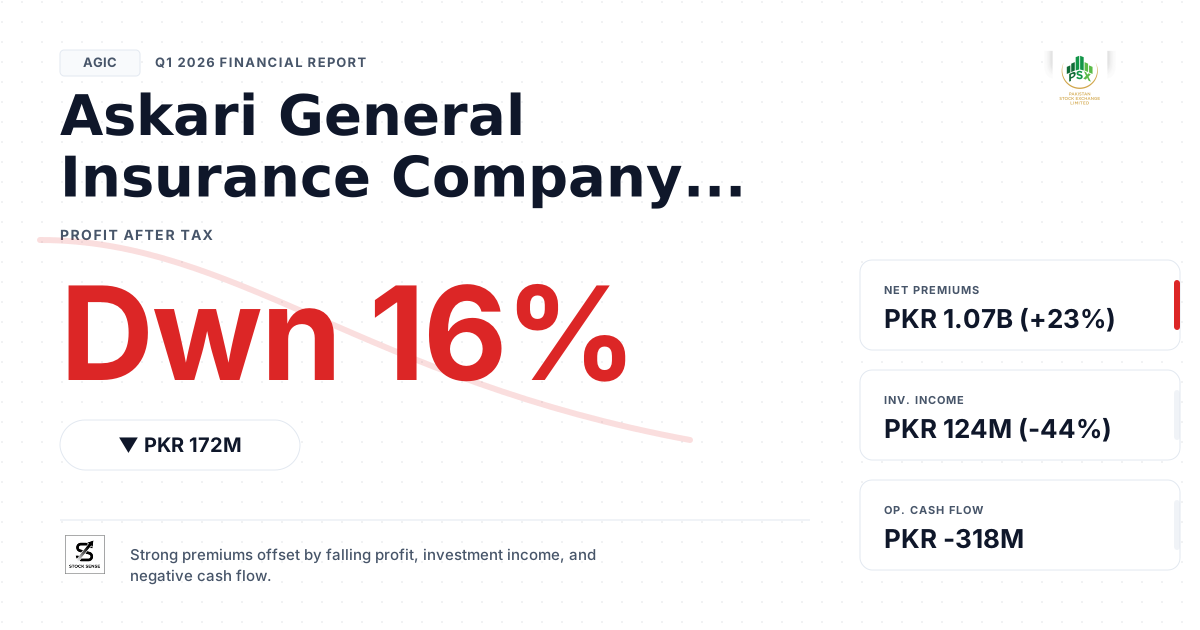
AGIC's top-line performance was strong, with net insurance premiums growing by approximately 23% to PKR 1.07 billion in Q1 2026, up from PKR 869 million in the same period last year. This indicates healthy business acquisition and market penetration.
However, this growth did not translate into improved underwriting results for the general operations, which declined by about 21% to PKR 43 million from PKR 55 million in Q1 2025. This suggests potential pressure on claims or acquisition costs within the core insurance business.
A significant drag on profitability was the investment income, which plummeted by approximately 44%, falling to PKR 124 million from PKR 219 million year-on-year. This substantial reduction had a direct impact on the company's bottom line.
Consequently, profit after tax (PAT) for the quarter decreased by roughly 16% to PKR 172 million, down from PKR 204 million in Q1 2025. Earnings per share (EPS) also saw a sharp decline of about 34%, settling at PKR 1.70 compared to PKR 2.58 in the prior year's quarter.
Perhaps the most unexpected and concerning development was the company's cash flow from operations. AGIC moved from generating a positive PKR 94 million in operating cash flow in Q1 2025 to utilizing a significant PKR 318 million in Q1 2026. This negative shift in cash generation from core activities warrants close attention.
Key Drivers & Segments
While the general insurance operations faced challenges in underwriting profitability and investment income, the Window Takaful Operations (OPF segment) showed a promising performance. Profit before tax from this segment more than doubled, increasing by 114% to PKR 57 million in Q1 2026 from PKR 27 million in Q1 2025. This highlights the potential of the Takaful segment as a growth driver for AGIC.
Management Actions & Strategic Signals
The decision to not declare any dividends (cash, bonus, or right shares) despite a positive profit after tax suggests that management might be prioritizing capital preservation or reinvestment into the business, or perhaps anticipating future capital requirements in a challenging economic environment. The significant drop in investment income could reflect a more conservative investment approach in volatile markets or simply less favorable market conditions for the company's investment portfolio.
The substantial negative operating cash flow is a critical signal. It indicates that the company's cash inflows from premiums, less outflows for claims, commissions, and expenses, were insufficient to cover its operational needs during the quarter. This could be due to timing differences in collections and payments, or a more fundamental issue in working capital management that needs to be addressed.
Investor Takeaway
AGIC's Q1 2026 results present a mixed picture. The strong growth in net insurance premiums is a positive indicator of the company's ability to attract and retain business. However, the decline in overall profitability, driven by lower investment income and weaker underwriting performance in general operations, is a concern. The significant negative operating cash flow is particularly unexpected and should be a key focus for investors.
Rational investors should closely monitor AGIC's ability to improve its underwriting profitability, stabilize investment income, and, most importantly, reverse the trend of negative operating cash flow in the coming quarters. The strong performance of the Takaful segment offers a glimmer of hope, but the overall financial health requires careful scrutiny, especially given the absence of any shareholder distributions.